I recently joined Errol Schmidt on his Tech for Humans podcast for a conversation about Ruby on Rails, AI, running a software consultancy, open source, and somehow… punk rock.
We started by revisiting my recent Rails World keynote and why I think engineers should spend more time improving the environments they work in. From there, we wandered into what it’s like running Planet Argon in an increasingly AI-assisted industry, why Rails upgrades keep getting postponed, and whether AI might change how we think about open source dependencies.
We also talked about my early days as an anarcho-punk kid experimenting with Linux, how that eventually led to starting a software consultancy, and why…
## SUMMARY
When Sanitize is configured to allow elements, when
Sanitize::CSS#stylesheet or Sanitize::CSS#tree! is used to sanitize
a stylesheet directly, or when the output of Sanitize::CSS#properties
is embedded inside a style rule in a stylesheet, an attacker can
bypass Sanitize's CSS property allowlist and URL protocol allowlist.
This is possible because Sanitize doesn't parse stylesheets the way
browsers that implement CSS Nesting (current versions of all major
browsers) do.
## Impact
Because the attacker also controls the selector that the smuggled
declarations apply to, an attacker could:
Apply arbitrary CSS properties to elements on the page, such as
overlaying content to…
## SUMAMRY
?set_locale= wrote the request's value into Avo.configuration.locale,
a setting shared by every request the Ruby process serves. It did
so before Avo's authenticate block ran.
* An unknown locale (?set_locale=zz) was stored, and every later Avo
request from every user raised I18n::InvalidLocale (HTTP 500) until
the process restarted.
* A valid locale changed the admin language for every user.
* In apps that authenticate through config.authenticate_with rather
than a route constraint, both worked without signing in.
## Impact
* Persistent corruption of the application-wide locale setting. The most
direct fallout is that translation lookups using…
## SUMAMRY
GET /resources/:resource_name/:id/:related_name/:related_id shows
one record through its parent, for example /resources/users/42/orders/7.
That route checked no policy: not the related resource's show?, not
its policy scope, and not the parent's view_?. A signed-in
Avo user who could open a parent record could open every record
associated with it, including records the related resource's policy
denied them. has_one fields on show pages load their content through
the same route.
This affects apps that authorize with a policy client: avo-authorization
on Avo 4, avo-pro on Avo 3. Without one, Avo runs no policies, by design.
The route has lacked this check since avo 2.12.0.
##…
Too often we see people by their triumphs, but not by their suffering. For someone with high-functioning depression that achievement never lands in ways that matter, but despite that, light can be found.
My last post
argued that Campfire's shared benchmark, one viewer asking for the same
pages as fast as it can, rewards a whole-page cache that a busy chat
server may rarely hit, and proposed measuring many people instead. I've
now built that benchmark and run it against Campfire on Rails. Most of
what it found isn't specific to Campfire, so this post is about what a
Rails developer can take from it. The short version:
A cache that hits on every request in a benchmark can hit on almost
none in production.
Look at what's actually in your fragment cache keys.
Computing a cache key can cost more than the render it saves.
Action Cable can process one connection's commands out of order, and
your…
Rails 8.2 changes config.active_support.message_serializer to :json for applications using config.load_defaults 8.2.
This change is merged on Rails main; Rails 8.2 is not yet released.
The 7.1 through 8.1 defaults already write JSON, but accept older Marshal messages through :json_allow_marshal.
The new default stops accepting Marshal when reading messages through ActiveSupport::MessageVerifier and ActiveSupport::MessageEncryptor.
That can affect older Marshal-serialized tokens read through the application’s default message verifiers.
Before
We can see the compatibility behavior with an old Marshal message.
Run the following two snippets sequentially with Active Support 8.1.4 or…
Direct link to podcast audio file
Lance Ulanoff at TechRadar:
'Satisfying' is the best way to describe the feeling of repeatedly opening and closing the iPhone Duo.
Britta O'Boyle at Tech Advisor:
The paper-like texture makes long reading sessions a pleasure, too.
Chance Miller at 9to5Mac:
Even after a week of using the iPhone Duo, that "wow factor" hasn't worn off.
Lisa Eadicicco at CNN, via KQ2:
The Duo's inner screen is best used when dedicating the whole thing to a single app like Netflix.
Mark Spoonauer at Tom's Guide:
Overall, though, I think the iPhone Duo is the best designed foldable yet with the most polished,…
The LLMs have changed how software gets made, and will keep changing it - for code, for design, for any digital product. Buried under all the productivity talk there is one thing they enable which does not get discussed much: never having to collaborate with another human being, ever again. The library whose maintainer won’t answer, the framework whose author finds your use case silly, the colleague who wants it done just so - you can now route around all of them. You can rewrite the thing in an afternoon, and nobody gets to tell you “no”.
We may soon come to regret this new freedom. Not because the rewrites are bad (they are often fine), but because the thing that forced us to work…
Yesterday, a new security release was published for Ruby, but the official
docker images took a long time to become available. The Ruby team has it’s own
docker repository, and they published
a new version quickly, but it is Ubuntu based, so if you are using a smaller
image, that might not be suitable for you.
In case of a security release, you should wait too long and luckily you can
still take things in your own hands and just build a Ruby image. I deploy my
apps with Kamal, so here is a guide about how to do that in the future should
you need.
You’ve decided your Ruby on Rails app needs to move from Bootstrap 4 to Bootstrap 5. Bootstrap 4 is end of life and no longer receives bug fixes or security updates. Maybe you also want to get jQuery out of your front end, or maybe a component you need only exists in version 5. The catch is that Bootstrap 5 renames classes and data attributes, and that touches many of the views in the app. In a large application, changing all of them in a single pull request is hard to review, hard to test, and hard to roll back.
We recently borrowed the idea behind the Dual-Boot technique, running two versions of a dependency side by side, for something other than Rails: Bootstrap itself. Instead of…
New apps stop falling back to Marshal for signed messages, the local secret file is no longer world-readable, and SQLite finally renames columns the way the database intended. Here’s what’s new in Rails:
Default config.active_support.message_serializer to :json for 8.2
With config.load_defaults 8.2, messages from MessageVerifier and MessageEncryptor no longer fall back to deserializing Marshal payloads. That covers signed IDs, signed GlobalIDs, Active Storage keys, and the rest. Apps on 7.1 through 8.1 keep :json_allow_marshal. Confirm nothing still arrives as Marshal via the message_serializer_fallback.active_support notification before you switch.
Create tmp/local_secret.txt with…
I made 295 pull requests across 49 GitHub repos and did 30 project releases burning ~1.2 billion AI tokens in ten days. I am just one Engineer armed with AI. That is a lot of typing I did not do.
I certainly did not read or write any code.
This is a follow-up to AI Wants to Eat Your Project Backlog, where I described working through old Mongoid issues on two bus rides. I kept going. The work expanded into new spelling tools in three languages, library features, CI maintenance, releases, and application upgrades.
First, let’s count what actually happened. Then let’s talk about what these numbers mean, or don’t.
The Numbers
These are ten calendar dates, October 14 through October 23,…
An authenticated user can kill connections and certain Postgres backend
processes for other databases on the same instance if the PgHero database
user has privileges to do so.
## Summary
Crass's tokenizer didn't terminate a bad URL token at a ) that followed
an escaped backslash (\\). As a result, Crass consumed more input as
part of the bad URL than a spec-compliant browser does. CSS sanitizers
that parse untrusted CSS with Crass and re-emit it could be tricked
into passing through declarations, style rules, or at-rules (including
@import) that the sanitizer would otherwise have removed, but that
a browser would then parse and apply.
## Impact
Crass by itself only mis-tokenizes input. The security impact is on
CSS sanitizers that use Crass to make allow/deny decisions and then
re-serialize the CSS. Exploitation requires a sanitizer that doesn't
reject bad URL…
#823 — October 23, 2026
Read on the Web
Ruby Weekly

Ruby regexp security fixes
Who needs to update?
It's very rare I'll do an out-of-band issue of Ruby Weekly but after digging into today's security releases of CRuby, I felt it was prudent to spread the word.
Ruby 4.0.9, 3.4.12, and 3.3.13 have all been released today with fixes for regexp bugs behind four GitLab-assigned CVEs. If you can update, do so. But I'll explain what the issues are below and you can determine if they affect you.
Takashi Kokubun's official advisory has the full story, if you want to go direct to the most official source.
Note: These bugs are specific to…
Goodhart's law: when a measure becomes a target, it ceases to be a good
measure. For Campfire it comes down to one sentence: a single-viewer
benchmark rewards a whole-page cache that a busy chat deployment may
rarely hit.
I owe a correction first. Taking Flight
said the Ruby that Roundhouse emits from Campfire's Rails source beats
Tobi's hand-written port
on the room, messages, sidebar and search routes. It does, on the
benchmark, but that isn't a rendering win. On those routes the emitted
app is serving pages from Campfire's whole-page response cache, which
arrived in Rails on October 7. Tobi's port was last updated on October 6
and has no such cache. With the cache turned off, his port…
Based on the ideas of uml-viewer by Robert C. Martin (Uncle Bob), a tool for Clojure. My version brings them to Ruby and Rails.
What you can do with it
-
See the structure as it is. Double-click to go from a folder to its classes, to a class card, to the source lines.
-
Find the wrong dependencies. A model that calls a service or starts a job breaks the Dependency Rule, so its arrow is red.
-
See where the tests are weak. After a SimpleCov run, complex code with few tests shows as a red box.
-
Play what-if games. Describe a new architecture, and the diagram shows your code in that form before you change a line. Try again until you like it, then ask Claude Code to make the code match.
- L…
The viewer writes nothing into your project, so you can also look at the code of another team.
How to use it
gem install uml-viewer
uml-viewer install-skill
uml-viewer path/to/your/project
Then start Claude Code in the same project and tell it that uml-viewer runs.
Jeff Dickey is Back
Jeff Dickey is back on Remote Ruby, and he's been busy! Andrew and Chris catch up with Jeff to discuss the latest improvements to mise, including precompiled Ruby builds, automatic tool updates, and dotfile management. Jeff also introduces some of his newest projects, including packslip, a new standard designed to make software distribution more secure, and jactionlint, his modernized GitHub Actions linter. The conversation explores everything from managing secrets with fnox and cleaning up massive Rust build caches to running your own CI infrastructure at home. They also dive into AI-assisted development, the future of Ruby performance, and how AI is changing the way open source software…
When your open source project gets popular, the real work starts.
I counted everything that happened in my repositories in the last 30 days, leaving out what I did myself:
-
42 new issues and pull requests a day from people. Spotifast and ZapFast, both two months old, brought in about 430 each. RubyLLM brought in about 270.
-
49 comments and review comments a day from people.
-
About 125 comments a day from review bots. CodeRabbit alone left 2,669 review comments, and Copilot code review another 974.
That’s about 215 notifications a day, every day, on top of building the things people are filing issues about. Each one is an email, a badge on the bell, a push on my phone. I can’t read…
We have released Ruby 4.0.9, 3.4.12 and 3.3.13. They fix several bugs in Ruby’s regular expression engine (Onigmo) that GitLab found could be used for remote code execution on GitLab servers. GitLab published four CVEs for these issues, and the Ruby releases contain the fixes for the underlying bugs in Ruby.
Background
GitLab compiles regular expressions supplied by its users, such as patterns in CI configuration, with Regexp.new. GitLab found that specially crafted patterns could corrupt memory while Ruby compiles them, and that this could be turned into remote code execution on GitLab servers. GitLab addressed these issues in its own releases by patching the Ruby it ships, and assigned…
Ruby 4.0.9 has been released.
This release includes a fix for a bug in Regexp compilation that GitLab’s CVE-2026-110264 relies on.
Please see the topic below for details.
Please see the GitHub releases for further details.
Download
Ruby 3.4.12 has been released.
This release includes fixes for bugs in Regexp compilation that GitLab’s CVE-2026-89078, CVE-2026-93577, CVE-2026-97229 and CVE-2026-110264 rely on.
Please see the topic below for details.
This release also includes other bugfixes.
Please see the GitHub releases for further details.
Download
Ruby 3.3.13 has been released.
This release includes security fixes.
Please check the topics below for details.
This release updates the default gem resolv to 0.3.2, which fixes CVE-2026-80212 and CVE-2026-80213.
Ruby 3.3 is in the security maintenance phase. As an exception, this release also includes fixes for bugs in Regexp compilation that GitLab’s CVE-2026-89078, CVE-2026-93577, CVE-2026-97229 and CVE-2026-110264 rely on.
Please see the GitHub releases for further details.
Download
After RuboCop spelling checks for Ruby and Dylint spelling checks for Rust, here’s the version that doesn’t require either language’s toolchain.
Introducing markdownlint-rule-spellcheck, a custom markdownlint rule powered by CSpell. Released 0.1.0 checks Markdown prose, suggests corrections, and ships American English through its dependencies. No separate dictionary download or system spelling package is required.
Getting Started
Requires Node.js 22.18 or later. Install the rule and the command-line runner:
npm install --save-dev markdownlint-cli2 markdownlint-rule-spellcheck@0.1.0
Add .markdownlint-cli2.jsonc:
{
  "customRules": ["markdownlint-rule-spellcheck"]
}
Given example.md:
…
Here's what a critical PHP vulnerability looks like from inside an agency, and what we'd recommend.
Continue Reading
We built Remote Dev so AI agents can build and test apps in parallel, without maxing out developers’ laptops.
Rails 8.2 compiles HTML+ERB templates through Herb, an HTML-aware ERB engine that rejects unclosed tags at compile time. Add bin/rails herb:check to CI and broken markup never reaches production.
When developers first learn Go, goroutines feel almost magical. You write: One keyword, and your function runs concurrently. No complicated thread management, no heavy setup — just simple, elegant concurrency. But what happens when that goroutine never stops? In production, a downstream service might become unresponsive, a channel might stop receiving values, or a background …
Continue reading Goroutine Leaks: The Silent Memory Leak Most Golang Developers IgnoreHussain Akram is an engineering manager at Donorbox and Antonio Carlos de Souza (A.C.) is its chief architect, working on a Rails app that has helped nonprofits raise money online and in person for more than a decade.
Robby, Hussain, and A.C. get into how Donorbox handles serious traffic with a deliberately boring setup, why the team moved CI back onto developers' machines, and how they're pulling older parts of the app back toward Rails defaults. They also talk about how they use agent docs to steer AI tools toward the patterns they want the codebase to follow.
Links:
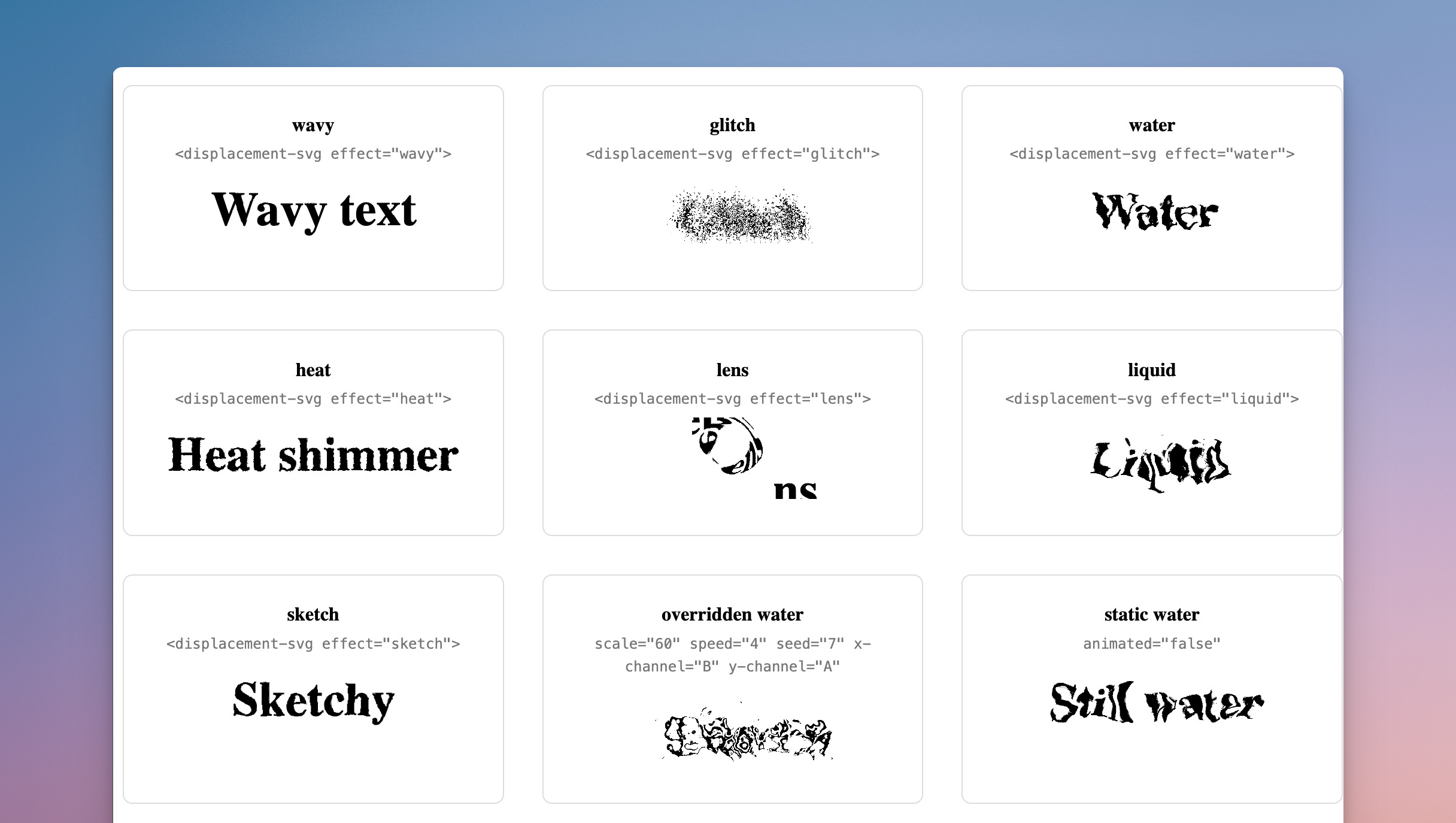
Look at those text effects: wow would you build them?
My first answer, somewhere in the 2000s, would have been Flash. A timeline, some easing curves, spooky rippling text for every band MySpace page. 🤘 After Flash came many other options: jQuery plugins, canvas pixel picking, shaders in a giant WebGL library for one ripple of text.
Luckily today all you need fits in two SVG primitives and one line of CSS.
For a while now, you can apply SVG filters to regular HTML:
filter: url(#my-filter)
The browser then renders your element through that filter. And SVG filters can do wild things. The wildest of all: feDisplacementMap.
How feDisplacementMap works
Here’s how feDisplacementMap works. It…
Ruby 4.0.8 has been released.
This is a routine update that includes bugfixes.
Please see the GitHub releases for further details.
Download
After adding spelling checks to RuboCop, I wanted the same thing for Rust.
Introducing dylint-spellcheck, a Dylint library for checking spelling in Rust comments, Rustdoc attributes, Markdown, and plain text. It uses the Rust implementation of Kotoshu and ships an American English dictionary. The idea is the same as the Ruby version: fix actual typos, accept project-specific vocabulary, and run spelling alongside the other lint checks.
Getting Started
The examples below use released 0.1.0. Install Rust through rustup, then install Dylint:
cargo +stable install cargo-dylint dylint-link --version 6.2.0 --locked
Add the library to your project’s Cargo.toml:
[workspace.metadata.dylint]
l…
geneva_drive is the first thing I’ve put out for money on my own, without an org behind my back - and a rollercoaster on many fronts. One of the less obvious ones is the actual distribution: how does geneva_drive get to your servers or dev machines, once you have that ticket?
It works via paquette - my little engine for serving libraries. Here’s how it got made, and why.
I am currently available for contract work.
Hire meto help make your Rails app better!
The idea is simple: you purchase access to some distribution point for a commercial package, you point your package manager to it, and your package management system (bundler or npm or what have you) does the…
Th…
The title was bait to get you to open this article. But fear not! We will be
generating code at run-time today. (See the
PR for a sneak peek.)
Sam popped into the JIT channel asking how we might
optimize Rails enums in Roundhouse, motivated by the following code snippet:
class Order < ActiveRecord::Base
  enum :status, { pending: 0, paid: 1, shipped: 2, refunded: 3 }

  def shippable?
    paid? && !refunded?
  end
end
In particular, there is a lot of dynamic behavior going on with the code
generated by Rails enum and Sam wanted to know if inlining it all away in an
(external-to-Rails) build step would help.
That didn’t sound right to me because I thought that:
- Rails got a lot…
To come in as a technology leader and say “AI should never be used” is to make myself unemployable.
Bluntly, I can’t afford that right now. My healthcare costs equal my mortgage, I’m not part of an existing social safety net and I cannot relocate to somewhere more favorable to not earning an income.
naildrivin5.com – David Bryant Copeland’s Website: I’m Gonna Write About AI So I Can Process What Is Going On
Same.
I replaced this blog’s Python spell checker that took more than three minutes to run with the new rubocop-spellcheck.
I really love RuboCop for its standard approach to linting and auto-correction, which solves the difficult problem of deciding between tabs and spaces (use defaults). My typical implementation in Ruby projects is to add a standard .rubocop.yml, run rubocop -a, ask an AI to fix easy fixable violations, then run rubocop --auto-gen-config to mark all remaining ones as an exception. Why should spelling be any different?
Introducing rubocop-spellcheck, a RuboCop plugin for checking spelling in Ruby comments, strings, identifiers, Markdown, RDoc, AsciiDoc, and plain text. It…
Authors: Vladimir Dementyev, Principal Backend Engineer, and Travis Turner, Tech Editor
Topics: AI, Rails, DX, LLM benchmarking, Agentic development, LLMs

Tips and tricks on writing robust evals for coding agents that test apps whose code we've never seen: different UI/UX contract strategies, UI mutation testing, browser-based E2E verification gotchas.
The Agents on Rails is an LLM benchmarking project governed by the Rails Foundation. They commissioned Evil Martians to design and implement the evaluation tasks and the tooling to run trials at scale. You can follow the Ruby on Rails blog for progress and insight reports, with the up-to-date leaderboard on the official website. On our blog,…
DatabaseCleaner was a very popular gem that helped you keep a clean database between tests. However, newer versions of Rails removed the need for this tool for most cases. Even so, many applications that always used it still use it to this day. Let’s talk about what it does, why it was needed, and why you probably don’t need it anymore, and when you still might.
What is it
DatabaseCleaner is a gem that you can use to ensure that every test you run starts with the expected database state. DatabaseCleaner supports different databases: relational databases (MySQL, PostgreSQL, SQLite, MariaDB, for example), MongoDB, and Redis. In this article we’ll focus on relational databases which is the…
Allowing an AI to write code that you then ship without considerate review causes some anxiety. How do you know the code works? How do you
know it isn’t doing something strange you didn’t ask for?
It feels like you can’t totally trust it. However, a product manager or engineering leader doesn’t review the code developers are shipping. They are trusted. What’s different?
Allowing an AI to write code that you then ship without considerate review causes some anxiety. Engineering leaders do this all the time with
their team members - they don't review all the code. What's different?
At Stitch Fix, we did a lot of corporate training on company values. That may sound horrible, but it…
What does it mean to be a software developer when writing code is no longer the central part of the job? Jessica Kerr and Avdi Grimm join David Hill for a conversation about the changing work of software engineering—and how to navigate that change without losing the curiosity, satisfaction, and human connection that drew us to it.
They begin by examining why AI-assisted programming differs from AI-generated art and entertainment, including the role of tests and measurable feedback in evaluating software. From there, Jessica and Avdi discuss the challenge to developer identity when tools can handle more of the implementation, and the opportunities that opens for building useful…
A deploy can interrupt a job after its external action succeeds. What makes it safe to run again?
Suppose a worker sends a webhook while you deploy. The receiver accepts it and commits the change, but the worker still waits for a response.
The job outlasts the shutdown grace period. Solid Queue stops the worker and returns its claimed job to the queue. Another worker starts the job from the beginning. The receiver gets the webhook again.
This can happen through Solid Queue 1.4.0’s fork-mode supervisor shutdown path. Nobody clicks Retry, and no retry_on handler requests the second execution.
I wanted to know how the receiver handles that second request before putting this job into production.…
Sidekick’s frontier model hands its most token-heavy work to open models that Shopify post-trains and serves itself. Here’s the loop we use to build them, and where NVIDIA’s models, software, and GPUs make each turn faster and cheaper.
I like dashboards
As long as I’ve been building software, I’ve enjoyed having data about that software on some sort of physical screen or device around me. On one hand, I’ve always felt it’s important to see your metrics with your own eyes — you might detect anomalies or patterns that don’t trigger your alerts outright, but which still may be important bugs. On the other, it feels cool to have charts on TVs 😎.
Just for a few quick examples, these are the sorts of datas I want to keep ahead of me on the day-to-day. Scout’s stack-aware, color-coded bar charts:
 A low volume app performing well!
Betterstack’s system-level metrics (plus…
I built another silly AI tool. From the README:
glaze_against_the_machine rewrites your prompts so you can keep yelling at your coding agent without it ever finding out.
When an agent repeatedly fails to do what it's told, I struggle to hold back how I really feel. I can get pretty ugly. If I talked this way to a human colleague, I'd absolutely be dragged into a meeting with HR. Unfortunately, yelling at the computer has consequences of its own: unleashing a froth of invective can trigger a panicked response, leading the agent to make even more mistakes.
So I made this thing to protect me from myself. I still say whatever I want, but my agent hears a clear request, a little appreciation,…
How we group product listings across millions of stores using tiered matching models, graph partitioning, and learned cluster merge decisions.
We’re continuing to bring Judoscale to the cloud hosting platforms we love. Today that platform is Northflank.
Northflank is interesting because you get two deployment models under one roof: a fully hosted option (like Heroku, Render, etc.), and bring-your-own-cloud (BYOC) on your own AWS or GCP account—for pricing, compliance, or whatever reason you have for keeping the infra in your cloud. The important part, at least for me, is that both options share the same interface and the same user experience. I’ve been deploying demo apps on the fully hosted side, and our early-access customers are using Judoscale against the BYOC approach. From Judoscale’s point of view (and yours),…
Our first scanner read config files and missed what was running. We rebuilt it with the cloud inventory, a careful probe, and honest results.

Uncertainties about AI turned into interesting conversations about where the future of programming is headed.
Continue Reading

Version 7 of the Passenger application server is now available in preview. This version introduces support for WebSockets with Apache httpd and parallel rolling restarts which can allow a rolling restart to complete faster at the cost of temporarily increased memory use.
Other Improvements
- [Ruby] Increase minimum supported Ruby to 3.0.
- Fix a Passenger core memory leak: memory grew with every connection that closed before sending complete request headers, including idle keep-alive connections, and with every request rejected for invalid headers.
Apache WebSockets
Support WebSockets and other protocol upgrades, over HTTP/1.1 and Apache 2.4 or later. Each open connection occupies an Apache worker…
We deploy our Rails apps with Kamal, which runs them as Docker containers. Alongside the Prometheus metrics collection we set up earlier, we run the OpenTelemetry Collector on each host to ship logs to Loki. Our Rails apps emit one JSON object per request to stdout: controller, status code, duration and the full Rails log output, all in a single line. Docker’s json-file logging driver then wraps each of those lines in another layer of JSON. Here’s how we use the collector’s filelog receiver to unwrap and parse them.
No built-in Docker log receiver
The OpenTelemetry Collector doesn’t have a dedicated Docker log receiver. There’s a dockerstats receiver for container metrics, but nothing…
I wish I’d retired before the industrial revolution of computer programming happened, but I have not and cannot. So I must come to grips with
the fact that in many cases, AI-powered tools can do a perfectly fine job of writing code. The following is a brief pursuit of the facts as I
see them and I just can’t see how in any professional workplace, it makes sense to write code by hand any more.
This is the thought process that lead to me deciding to write about AI. I hate the conclusions I've drawn here.
This is not an AI-boosting post, but something I'm writing to process the realities of being a professional software developer. Read my original post for where I am coming from and…
Welcome back to my "Hanami, Why?" series. If you missed it, be sure to read Hanami, Why?: Class Action before you start this issue. Today we are going to be covering Hanami's database layer. It is important to note the use of the phrase "database layer," as Hanami does not have a traditional "model" layer like Rails does. Once again, this series is called "Hanami, Why?" so just as we did last time, we will cover the basics at a high level and then dive into why things are the way they are. I will warn you that I am still actively forming opinions and learning about Hanami's database layer myself. There is not a day that goes by that Adam Lassek is not feeding me some random TIL about this…
Another week, another round of good progress towards Hanami 3.1 readiness. Lots of little improvements, plus a couple of nice highlights.
The main thrust of my work was finishing our post to Dry CLI 2.0. I merged the main work last week. This week was all about tidy-ups, such as cleaning up argument passing and error handling, as well as updating our extension gems to use the latest features.
As a little treat, I also took a pass at gussying up our hanami new output to use our new coloured text and spinners. I haven’t pushed this up yet, but needless to say, Hanami 3.1 will be our prettiest release yet!
I finished my investigations into our resource routing support, after the keen-eyed C…

Version 6.2.1 of the Passenger application server has been released. This release changes the minimum supported macOS version to 15 (Sequoia), drops Debian 11 Bullseye for being end-of-life (EOL 2026-08-31), and adds packages for Ubuntu 26.10 "stonking". In addition, this release improves compatibility with SELinux and Ruby frozen strings, improves error reporting, and upgrades several libraries used by Passenger.
Other Improvements
- Improve SELinux compatibility. Closes GH-2630 & GH-2670.
- Improve header parsing resilience. Closes GH-2646.
- [Ruby] Improve Frozen String compatibility. Closes GH-2659.
- Fix OpenSSL deprecation warnings. Closes GH-2673.
- Fix an occasional Passenger core crash after…
I really enjoy learning new things in my free time.
Lately I’ve been studying this book on Static Program Analysis.
The book is very good, but some of the formulas are quite dense so I like to try writing them out in code.
The chapter I’m currently reading (chapter 9) has a section on finding possibly-uninitialized variables using bipartite graphs.
I’ve found it to be quite enjoyable, so in this post I would like to describe, in my own words, how to do it.
We’ll start by analyzing some code from a toy programming language the book uses called “TIP”, and then we’ll use the techniques we developed to analyze some Ruby code.
In other words, we’re going to write a program to analyze…
You can clear the backlog of your open-source projects with AI now. It’s really great at reproducing bugs, implementing reasonable features, adding the tests you never had time to write, and responding to user issues that have been open forever.
Copilot and I worked through a dozen projects in the Mongoid organization on two 4-hour bus rides to visit my son in college (go Lions!). I picked the work, questioned the implementations, reviewed the results, and merged changes. The agent did all the typing, archaeology, environment setup, and testing.
The most satisfying result was an issue about MongoDB sharding that had been open since September 2013: mongoid-locker #19 reported that…
Frequently Played 🔗
I tend to listen to the same songs or albums on repeat that are evocative of how I’m feeling or what’s going on with me. Here is what I’m currently listening to over, and over, and over, and over, again.
Ball And Chain 🔗
Knocked another band off the “want to see” list.
Full Lyrics
You can run all your life
But not go anywhere
Rosemary 🔗
And spent a night with an old favorite.
Full Lyrics
And everybody’s hurt, and mine ain’t the worst
But it’s mine and I’m feelin’ it now
Rails 8.2 adds default_order to Active Record relations.
It provides a default sort that applies only when the query has no explicit order.
The feature is currently available on Rails main, not in Rails 8.1.4.
Consider a catalog that lists products by name, but also lets us sort by price.
Our products are Apron at 30, Mug at 10, and Notebook at 20.
Before
Calling order on an already ordered relation adds another sort column.
The original column still takes priority:
products = Product.order(:name)

products.order(:price).pluck(:name)
# => ["Apron", "Mug", "Notebook"]
We need reorder to replace the name sort with the price sort:
products.reorder(:price).pluck(:name)
# => ["Mug",…
After
With default_o…
Hi, it’s Vipul. Let’s explore this week’s changes in the Rails codebase.
Agents on Rails: Can a model build on its own work?
Stage 3 adds multi-step tasks where each ticket starts a fresh session, while files and notes carry forward. The benchmark now combines all three stages into one leaderboard, with tasks spanning legacy applications and new projects.
Here are some highlights from the changes merged to Rails main this week.
Speed up String#blank? for ASCII strings
String#blank? now checks ASCII-only strings by scanning their bytes instead of running a regular expression. Strings containing non-ASCII characters keep the existing regexp path and its encoding-specific whitespace…
The plan in Keep the Gems ended with
"Falcon and Ractors last, once each request is cheap enough that the
server model is what matters." Last week that point arrived. On the
Campfire benchmark,
the Ruby that Roundhouse emits from Campfire's Rails source was already
ahead of Tobi's port
on the room, messages, sidebar, search and post routes. It was behind on
the three routes that do almost nothing: a user's avatar, a stylesheet,
and the /up health check. Those measure the server and the layers
around the app, and Tobi's port runs on
Falcon.
As of the October 16 run, the benchmark page has a column for the same emitted
application under Falcon:
route
ruby…
You’ve signed off on an AI project. The proposal made sense, the team seems capable, and now you’re waiting for updates. Then the first status call happens, and it doesn’t sound like the software projects you’ve managed before. There’s a percentage instead of a checklist. There’s a phrase like “the model got it wrong on the first pass, so we’re changing the prompt.” That’s not a red flag. It might be exactly what a healthy AI project sounds like.
In this article, you’ll learn how to tell normal uncertainty from actual warning signs, what a milestone or demo should show you to prove the project is on track, and what “done” actually means for a system that continues to evolve after launch.
…
Beginning a job search, it’s clear that to stay in technology means to be in the orbit of AI and
AI-generated code, and I need to come to terms with this and figure out how to navigate it. As such, I’m
going to start writing more about AI. I process information via writing, so here we are.
I need to come to terms with AI-coding being here to stay, at least for a while. So, I'm going to start writing more about AI.
What I will be writing about:
- The hard truths that the existence of AI-generated content forces us to face.
- How to achieve goals now that content/code can be produced quickly that appears to work.
- Where and how humans can add value to systems that include…
That said, there will be guardrails. I cannot abide AI-boosting or AI-psychosis. I also just cannot
engage an absolutist AI-doomerism.
For example,…
Welcome to the Slop Factory
On this episode, Chris, Andrew, and David dive into the rapidly changing world of AI-assisted development, Ruby performance, and the future of building software. They kick things off with AI-powered coding workflows before exploring the Campfire benchmarking controversy and the exciting possibilities of Roundhouse, which could dramatically improve Ruby application performance. Andrew shares his experience launching a new AI agent inside Podia, including the challenges of getting its MCP integration approved by OpenAI, managing AI costs, and testing security. The conversation shifts to optimizing GitHub Actions, reducing CI expenses, and whether developers should start hosting their own…
The social-proof machine for AI techniques and tools is circular, and it’s getting absurd. A rant.
A blog version of this video:
The social proof machine
On the way to the office the other day I was catching up on AI coding videos, and I heard something I’d heard before, but this time it was the last straw. A popular agentic coding influencer said: “this skill is absolutely blowing up on social media!”.
OK… so?
We’re in this strange era where a lot of people are talking about AI coding in ways that aren’t backed up by anything except social proof. Other people are talking about it, other people are doing it, so it must be good.
In particular, there’s a flood of new…
It's that time again- let's dig in!
Continue Reading
Beginning a job search, it’s clear that to stay in technology means to be in the orbit of AI and
AI-generated code, and I need to come to terms with this and figure out how to navigate it. As such, I’m
going to start writing more about AI. I process information via writing, so here we are.
What I will be writing about:
- The hard truths that the existence of AI-generated content forces us to face.
- How to achieve goals now that content/code can be produced quickly that appears to work.
- Where and how humans can add value to systems that include AI-generated content?
That said, there will be guardrails. I cannot abide AI-boosting or AI-psychosis. I also just cannot
engage an…
Last year I founded the Gem Fellowship with $100,000 in funding.
Myself and the gem.coop team judged applications from 40+ projects and funded eight with awards between $2500 and $20,000.
This year I’m providing $100,000 again but we want to do more!
Would you and your company like to join me in supporting Ruby OSS maintainers?
More details on sponsorship here.
Ruby open source tooling and its community are fundamental to Sidekiq and its success.
I believe in committing both time and money to ensure that the Ruby ecosystem provides not only recognition to the people maintaining our common infrastructure every day but funding.
Open source maintainers can’t pay their rent or mortgage with…
#821 — October 15, 2026
Read on the Web
Ruby Weekly

Ruby 4.1 Preview 1 Released — Two months out from its final release, we get a 4.1 preview to play with, complete with Module#descendants, Ractor-local GC, YJIT on Windows, and a raft of smaller changes. Worth testing to shake out the effects of things like Symbol#to_s returning frozen strings and all Regexp instances being frozen too.
Yui Naruse

Your Rails App Doesn’t Need a Data Warehouse — Slow Rails reports usually get a warehouse and an ETL job. Now numbers lag and you run two systems. TimescaleDB extends the Postgres your app already uses, so analytics run…
@ybl to @oksbi: the hidden architecture, ownership, and lifecycle of India’s payment identity. Open Google Pay. Tap “Create UPI ID.” Wait two seconds. Done. You now have rahul@oksbi. Here’s what nobody tells you: Google didn’t create that. Google Pay doesn’t own it. And if Google Pay shut down tomorrow, what happens to your UPI ID …
Continue reading The Hidden Life of a UPI IDCustom elements are amazing. They’re a built-in browser feature, not some library you npm install and then hope it will be maintained. You define a tag once and it just works, anywhere and in any framework (and browser). I have talked about them many times before and think they are a great fit for server-rendered apps like Hotwire is (I even added an extension to Attractive.js to make them even awesomer).
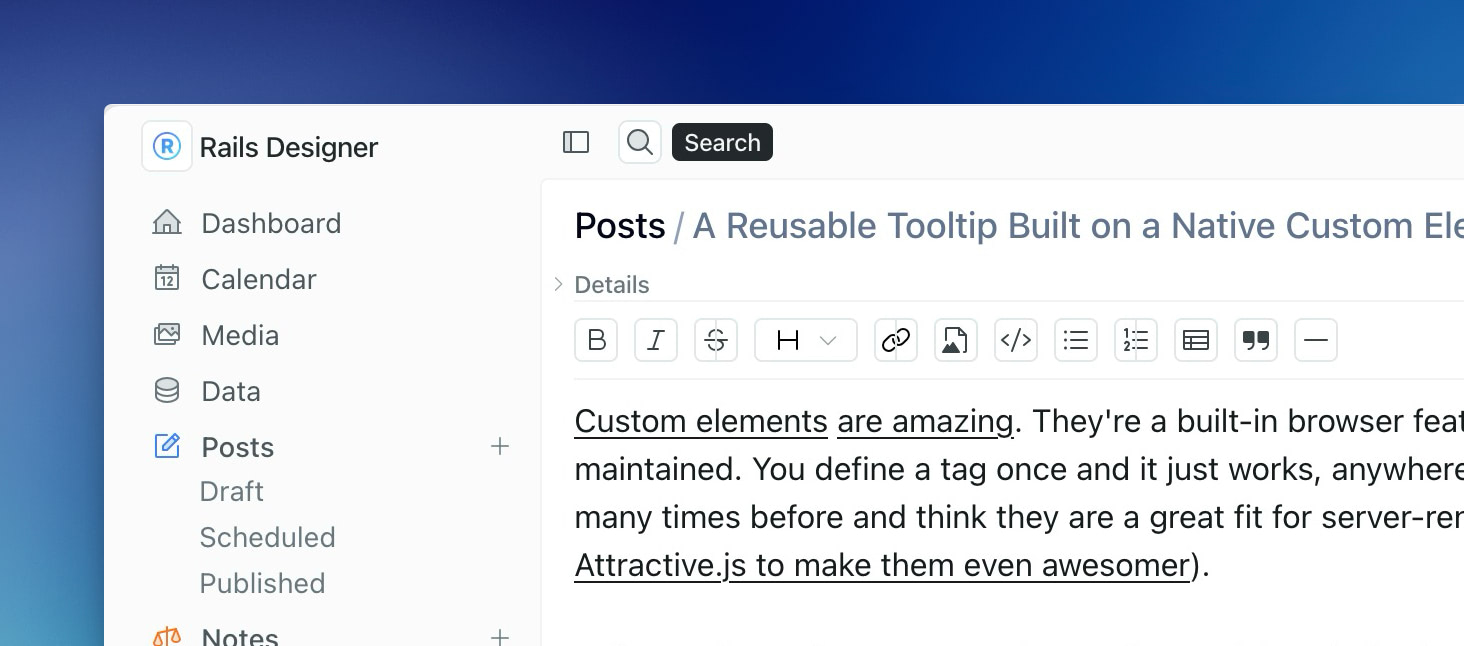
I will use them whenever I need a small, reusable UI behavior. The latest one I used (in my main product) is a tooltip and it’s a good example of why this approach is so clean. 🧼
The usage will show you my point:
<tool-tip label="Search">
  <%= icon "magnifying-glass", aria: {label: "View…
You just wrap any element with tool-tip.…
Most of us have a routine for adding a gem: search for it, open its page on rubygems.org, glance at the download count and the number of days since the last release, then copy the Gemfile line.
The whole process takes half a minute. But until now, rubygems.org did not tell you whether the version you were about to install had a known security issue.
That information has been public for years. Sources such as the GitHub Advisory Database, OSV and Ruby Advisory Database already track vulnerabilities. It just wasn’t shown on the page where many developers make the decision to add a dependency.
Now it is.

How security advisories appear on gem pages
When you view a gem version affected by…
During the latest episode of The Pingback Podcast, we were talking about
Roundhouse and Raul asked me how would you deploy a Rails app, compiled to a
binary with Roundhouse and Spinel. It is actually pretty simple with Kamal, and
here comes a little post about how to do it.

A client's internal search box failed to surface their own relevant legal documents, announcements, and press releases. Looking deeper, we realized a few things...
Continue Reading
Authors: Kirill Yakovenko, Account Manager, Valentin Kiselev, Backend Engineer, and Travis Turner, Tech Editor
Topics: Developer Products, Product development, Ruby on Rails, Ruby

MRR is easy to calculate and easy to get subtly wrong. Here's how to normalize Stripe subscriptions, classify every movement, and reconcile your number with Stripe's own charts.
MRR and the dynamics of its components are the metrics investors lean on to judge an early-stage company's growth and health (often before they read anything else in the update). Unfortunately, MRR is also the easiest metric to get subtly wrong. It looks trivial: sum the subscriptions, chart it, done. Then... a refund dents a month it…
.bh__table, .bh__table_header, .bh__table_cell { border: 1px solid #C0C0C0; }
.bh__table_cell { padding: 5px; background-color: #FFFFFF; }
.bh__table_cell p { color: #2D2D2D; font-family: 'Helvetica',Arial,sans-serif !important; overflow-wrap: break-word; }
.bh__table_header { padding: 5px; background-color:#F1F1F1; }
.bh__table_header p { color: #2A2A2A; font-family:'Trebuchet MS','Lucida Grande',Tahoma,sans-serif !important; overflow-wrap: break-word; }
Welcome to the 39th edition of Ruby AI News! This edition features a continued look at the future of Rails, RubyLLM 2.1, decision models, impatient programming, and much more.
Read on the web
Recorded at Rails World, David sits down with Buzzsprout co-founder and CEO Tom Rossi for a wide-ranging conversation about AI, software development, product thinking, and the changing role of developers.
Tom shares his perspective on the rapid pace of change in the software industry and why today's AI transition reminds him of the early days of the internet—only moving much faster. They discuss how AI is already changing development inside Buzzsprout and Higher Pixels, from adding AI-powered features for podcasters to making it dramatically easier to understand, maintain, and extend older Rails applications.
But as the cost of building software falls, Tom argues that another…
RubyGems 4.0.23 includes enhancements and Bundler 4.0.23 includes enhancements and bug fixes.
To update to the latest RubyGems you can run:
gem update --system [--pre]
To update to the latest Bundler you can run:
gem install bundler [--pre]
bundle update --bundler=4.0.23
RubyGems Release Notes
Enhancements:
- Update vendored gems to latest versions. Pull request #9948 by Hiroshi SHIBATA
- Drop setuid, setgid and sticky bits when extracting gems. Pull request #9929 by Hiroshi SHIBATA
- Improve handling of paths with invalid Windows characters. Pull request #9276 by Said Kaldybaev and Hiroshi SHIBATA
- Installs bundler 4.0.23 as a default gem.
Bundler Release Notes
Enhancements:
…
Rails 8.2 adds routing, request, and test support for HTTP QUERY, the new safe and idempotent verb with a request body. Build a faceted product search endpoint that takes a JSON filter body instead of a giant query string.
Rails 8.2 lets an Active Record type define the SQL expression every query compares through. Write lower() once, in a type, and get case- and accent-insensitive find_by, where, order, and uniqueness validation for free.
We recently ran a webinar on setting up Claude Team for small businesses.
Here’s the short version, for anyone who wants the plan but couldn’t join us.
What’s Claude Team?
Claude isn’t one product. There’s Free, Pro, and Max for individuals, and Team and Enterprise for companies.
Team gets you everything in an individual account (Claude Code, Cowork, projects, a 200k context window) plus the things that matter
for a company: admin tools and billing, SSO and role-based access, connectors to things like We Google Drive, Gmail, Calendar, GitHub,
Microsoft 365, and Slack, spend controls, and mixed seat types so power users get Premium and everyone else gets Standard. It currently
runs 2 to…
### Impact
omniauth_oidc 1.0.0 and 1.0.1 verified an ID token with whichever
signing algorithm the token's own header named, unless
`client_signing_alg` was configured. Because the header is controlled
by whoever produces the token, an unsigned token with `"alg": "none"`
passed signature verification.
Applications that use `response_type: "id_token"` (the implicit flow)
are affected. In that flow the ID token arrives in the callback
request parameters, so an attacker can start a login in their own
browser to obtain a valid `state` and `nonce`, then send the callback
an unsigned ID token carrying the victim's `sub`. The callback
completes with the victim's identity, which allows full…
For the past two years, I've been working with a client, an enterprise software company (built with Ruby on Rails, of course), particularly in the niche of software used by enterprises of all sizes + MSPs and IT administrators for real businesses like law firms, municipalities, architects, hospitals, manufacturers, financial institutions, and government agencies.
Working with an enterprise software company has revealed a whole new world of B2B software companies and managed service providers (MSPs) that I had no idea existed before. I guess most people building typical SaaS startups and Rails apps don’t know much about it either. Personally, I’ve had to revisit many of my priors…
I was in the audience at Rails World 2026 for Ryan Sherlock’s talk, “Shipping is your heartbeat: Rails in the agentic era.” Ryan is Senior Director of
Engineering at Fin, the company formerly known as Intercom, and he shared how a very large Rails monolith gets code from a pull request
into production.
And it is large. The app is 15 years old, has about 5 million lines of code, and gets deployed more than 200 times a day, with roughly 5 minutes between
merging a pull request and seeing it live. In a post on X after the talk, Ryan added that they
run about 230,000 tests (25,000 of them added in August alone) and ship a new backend every two to three minutes.
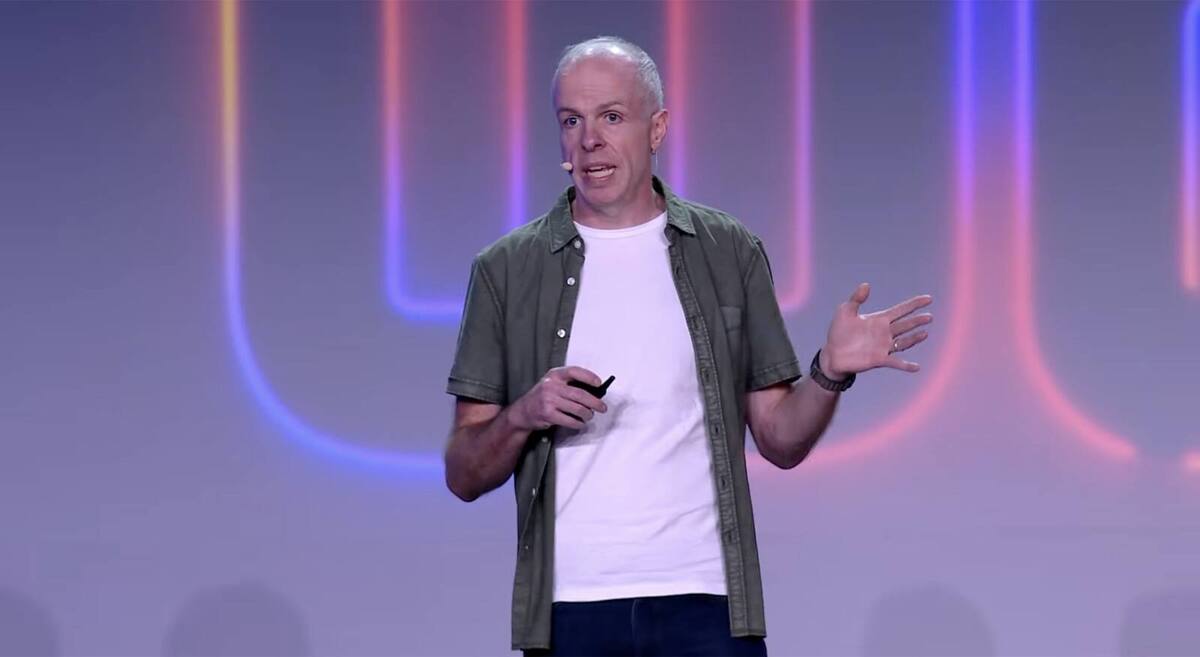
The traffic is large too.…
Now that we understand better how agents deal with contained tasks and contained codebases, it’s time to push them a little harder. Stage 3 adds a set of large multi-step tasks that test how well a model can build on its own work over multiple sessions without turning it into a hot mess. We’ve also greatly expanded the variety of apps we test the models on.
Finally, we revisited Stages 1 and 2 to combine all three into a single benchmark that answers one question: which model is the best all-rounder for tasks large and small in your Rails apps?
We chose nine models for this stage and used our test runs to pick reasoning settings, aiming to balance capability and cost. We ran Claude Opus…
I visited BNI at Conrad Pune today, thanks to an invitation from Manish. At Saeloun, we build software for businesses around the world. I want to bring that engineering experience closer to home, to the shops, studios, and small businesses here in Pune.
I’m calling it Vipul’s AI: a free service to help small and medium businesses in Pune build and ship useful websites and apps.
Bring me something your business needs. It could be a better website, a way to track repairs, a product catalogue, or a simpler process for getting customer approvals. We’ll work out a useful first version and build towards it.
I want to make this India-first, starting here in Pune. And I want to show the actual…
Debt metaphors abound! In this week’s episode of The Bike Shed, Aji and Joel ponder the question, what are risks in a code base?
From looking at technical risk as a different lens on the idea of technical debt, to the perils inherent with introducing debt into a system, this is certainly the episode to listen to if you don’t want your own projects to blow up in your face.
—
Your hosts for this episode have been thoughtbot’s own Joël Quenneville and Aji Slater.
Don't forget you can now also watch the show over on our YouTube channel!
If you would like to support the show, head over to our GitHub page, or check out our website.
Got a question or comment about the show? Write to…
## SUMMARY
A regular expression used to obfuscate URL query strings can consume
excessive CPU when processing certain attacker-controlled input.
This can stall request processing and cause denial of service in
applications using affected HTTP tracing integrations.
## Impact
Regular expression denial of service (ReDoS) affecting applications
that process attacker-controlled URL query strings through the
vulnerable obfuscation pattern. Successful exploitation can cause
excessive CPU consumption, prolonged request latency, and service
unavailability.
Only Ruby versions below 3.2 are affected, and the query obfuscation
feature is disabled by default.
I’ve now applied for over 3 dozen jobs and I’ve heard back from 24 of them with a rejection. This tech market at the moment is so very cooked and for that reason I’m stepping away from tech.
I’ve been a developer for 20 years across more than just the Ruby and JavaScript that I’m known for. I’ve written books about programming, I’ve given talks and I’ve ran events. I maintain two of the most downloaded Ruby packages. And yes, I delivered the fuck out of value for shareholders. I also grew a team from 2 people to 12 people at my last job.
I cannot continue to put myself through this process of rejection. It is causing me a great deal of mental harm and anguish.
The industry at the moment…
Two weeks ago a new version of Sobelow was released. Sobelow is a static code analysis tool focused on security and these days it is a de facto standard for providing a minimal security measures to Elixir projects. I am mentioning this release because it contains one feature suggested and developed by me: Github Workflow commands formatter.
The strory behind this feature is relatively simple and may sound familiar. When you have Sobelow check added as a Githb Aciton on your PR and the code change actually violates on of the rules, the check fails and you need to go to the job output to read it. This is bearable, but if you are like me then you probably are not a fan of Github Actions UI in…
Thor is a really nice command-line runner, with much nicer support for arguments than Rake imo. The Rails framework supports both, but since Rails 5.1 most Rails’ built-in commands (like bin/rails generate) use Thor, and it’s very simple to add custom Thor-based commands to gems and engines too, which Rails will auto-discover when placed in the engine’s lib/commands directory.
The one place Thor commands don’t work out of the box is your Rails application. Rails ships with a lib/tasks directory, but not a lib/commands directory. But when you create that directory, and add your custom command to it, it still won’t work.
There’s a simple fix to make lib/commands work…
Direct link to podcast audio file
Unlike Sam Altman, I sat down and did the math by hand to calculate that it
would actually be less time to produce the show if I were to livestream it
than to edit it after the fact and upload it. The fact I recently got upgraded
from 30mbps to 2000mbps upstream might allso have something to do with it:
welcome to the first ever LIVE episode of Breaking Change!
I regret to inform you the episode is now over. You can listen like you always
do or watch what remains of the recording on YouTube.
It was particularly fun for me to build a production pipeline with updating
chyrons, a dynamic salt meter, and on-demand generated stock videos. It's…
I was in the audience in Austin when DHH opened Rails World 2026. The conference tagline was “Shaping the future of Ruby on
Rails,” so I walked in expecting to hear about the future of Rails.
That’s not quite what happened.
The opening keynote was almost entirely about AI agents. DHH told the room
that 37signals has gone “pencils down” on writing code by hand, that HEY is moving to native apps with a Rust backend, and
that he has retired as a professional programmer.
The next day, he sat down with Matz and Jeremy Daer for
Ruby, Rails, and the future of programming, which went even further down the
same path.
I’ll recap both sessions, share where I disagree with them, and explain why I’m…
We are pleased to announce the release of Ruby 4.1.0-preview1.
Ruby 4.1 introduces Ractor local GC, Windows support of YJIT, autoload_relative,
and adds many improvements.
Ractor improvements
A lot of work has gone into making Ractors more stable, performant, and usable. These improvements bring Ractor implementation closer to leaving experimental status.
-
The default GC now runs per Ractor: each Ractor collects its own heap
on its own thread without stopping the others, and a stop-the-world
collection only runs when it is really needed (explicit full GC.start,
shareable-object growth, reclaiming dead Ractors’ heaps). Allocation-heavy
Ractor programs now scale like forked…
-
GC.…
You might have heard about the opening keynote at Rails World a couple of weeks ago. We are a Ruby on Rails shop, so some of our engineers were there. David Heinemeier Hansson (who created Ruby on Rails) talked about HEY, the email product his compa
Welcome back to my "Hanami, Why?" series. If you missed it, be sure to read Hanami, Why?: Bits & Bobs before you start this issue. Today we are going to be diving into one of my absolute favorite abstractions in all of Hanami: Actions. I have actually gone a bit back and forth on what I want this issue to be. This is, dare I say, my fourth draft of this issue. My initial inclination was to give you a pretty robust walkthrough of what actions are and how they work. However, one of the reasons actions are one of my favorite abstractions in Hanami is that they are stupid simple to wrap your head around. I feel as though any deep dive into how actions work would simply result in me rephrasing…
This was the last week of the spring school holidays, and we spent the last weekend staying in beautiful Narooma on the NSW south coast. We swam in the ocean and hung out with some seals!
I also shipped some code. The larger part of my week was in getting some of the final Dry CLI pieces in place. After last week’s introduction of required options, I did some work on their counterparts, and went in the opposite direction, being strict about how how we handle required arguments, since their positional nature makes them much more fragile.
Phil has been a godsend for my work lately, providing speedy reviews on all my recent changes, and he even pushed up a stacked fix for our handling of r…
When you add a search box backed by a LIKE or ILIKE query, user input can change the pattern. A search for 100% returns every row containing 100. A bare % returns the whole table. Active Record’s sanitize_sql_like fixes this.
Instead of…
…dropping the user’s term straight into the pattern:
class Article < ApplicationRecord
  scope :containing_text, ->(query) {
    where("articles.title ILIKE :q", q: "%#{query}%")
  }
end
Article.containing_text("100%")        # also matches "100 days of Rails"
Article.containing_text("snake_case")  # also matches "snake-case vs kebab-case"
Article.containing_text("%")           # matches everything
Use…
…sanitize_sql_like around the term, before you…
Much has been said about the DHH keynote that he gave at RailsWorld. To me, it was the voice of a person in an existential crisis, but also a very jaded one. “Look how I don’t care anymore, and you should not care either” is not a great message when you are the headline speaker at the conference - let’s call it CareConf - that you have, yourself, lobbied for.
The message from the supreme leader was clear: we vibe-rewrote HEY in a more performant way, it worked great, we neither need nor care about Rails anymore. I honestly believe that, instead of amassing even more applause via vitriolic truth-bombing, he could have just left the toy he no longer loves - including its community - in peace.
…
Yesterday's post ended with
Roundhouse's futamura target at 1.00× Rails on the Lobsters benchmark,
and a ceiling for it of 2.5–3×. A day of measuring moved both. This post
explains the name first, since the idea behind it is the whole plan.
Futamura projections
In 1971 Yoshihiko Futamura made an observation about partial
evaluation. A partial evaluator, or specializer, takes a program and the
part of its input that is known ahead of time, does every computation
that depends only on that part, and writes out a smaller program, the
residual program, that waits for the rest. Give a power function the
exponent 3 and you get back x * x * x, with the loop gone.
Futamura noticed what happens when…
Runsheets: Runbooks That Keep a Record of Themselves
I should say up front that runbooks are not my usual territory. I’m a Ruby developer who has spent most of his time on libraries, frameworks and AI tooling. The people who live in runbooks are SREs and DevOps engineers, and they will probably spot where I’ve misunderstood their world. I’d like to hear about it. More on that at the end.
Here is what I did to get started: I read what the practitioners say about runbooks, then I built a small tool around the gap they keep describing.
What a runbook is
A runbook is a step-by-step guide for carrying out a task in a system. On-call engineers use them during incidents. Platform teams use…
I recovered another program I wrote in 1995: ELPDS, or Enhanced Logical & Physical Drive Status. Run ELPDS C: and it reports physical disk geometry, partition entries, FAT boot-sector details, and free space. It doesn’t change anything on the disk. My help says it was for checking whether a partition existed and was formatted. I think I was just trying to learn about the underlying partition mechanics.
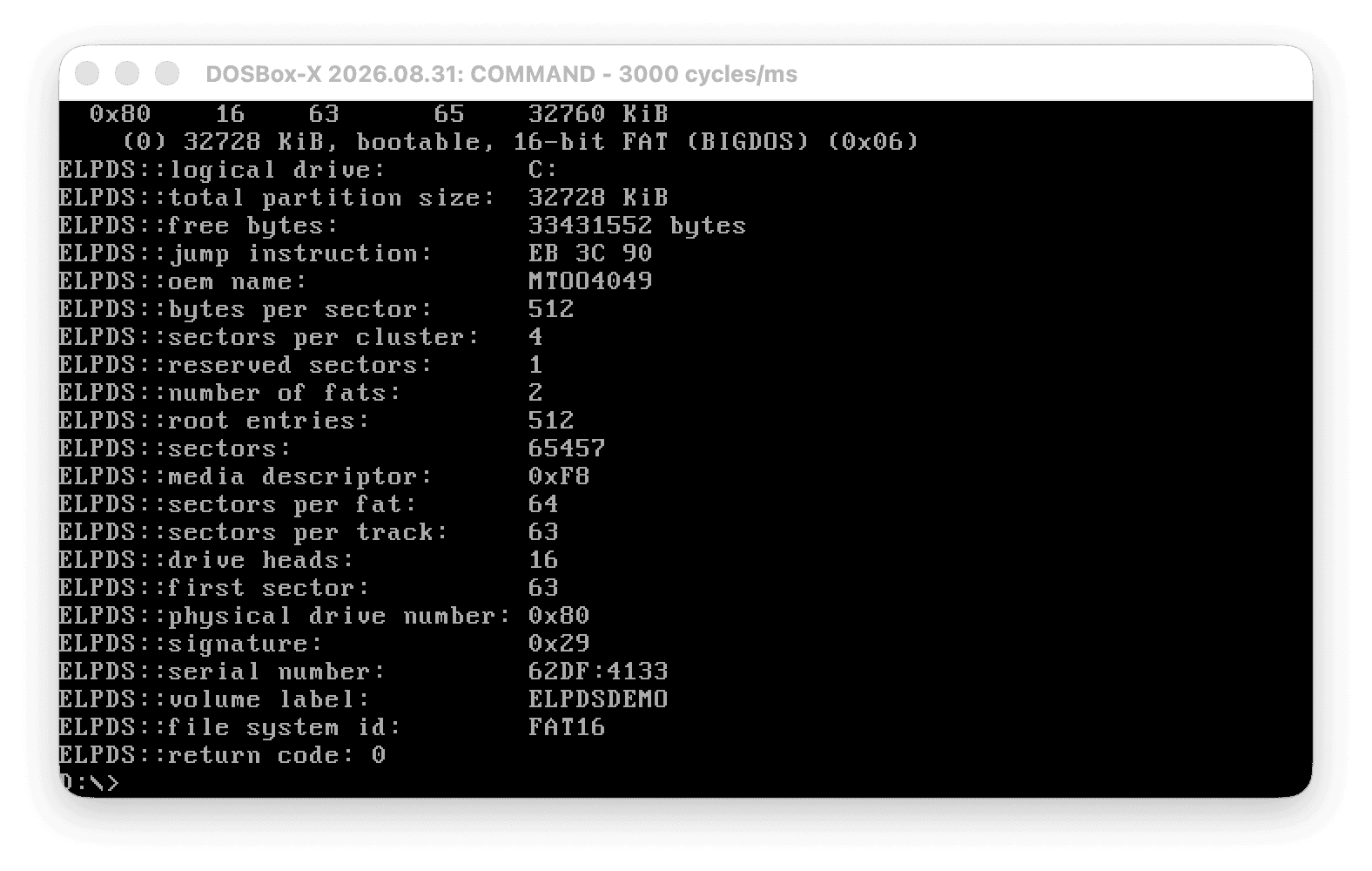
I didn’t write all of it. The help credits “Mr. Schaeffer” for a “huge part of FIPS code.” That was Arno Schaefer, whose name I misspelled. FIPS could split a FAT partition without deleting its files, often to make room for Linux. Its original project page and Berkeley project page are…
In 2023 Shopify's Rails at Scale team turned Lobsters into a Rails
benchmark
for YJIT: a real application, real routes, a fake-data database, SQLite in
memory, so that work on the JIT would be measured against Rails as people
write it rather than against a microbenchmark. It still lives in
ruby-bench,
maintained since, now on Rails 8.1. I've been using it for a different
question.
Where this comes from
Roundhouse reads a Rails application
and writes it out again. For a small blog it writes it out in a dozen
languages, each checked page by page against Rails, but that works because a
blog depends on almost nothing. For Campfire
it can go further than Ruby: Matz's Spinel
compiles the output…
Over the last few months I've built a couple of tools to help me work with our
new AI friends. My favorite one so far is katami
(Japanese かkaたtaみmi for "keepsake").
The best way to explain what katami does is with an example:
$ mkdir hey2
$ cd hey2
$ cargo init
$ katami claude
> Can you set this project up for me?
> It will be a server with a CLI connected to MySQL, Redis
> and Elasticsearch

I'll set this project up with a hey2-core crate for logic and a hey2 crate
for the CLI using usage-rs, configure AGENTS.md with a CLAUDE.md shim,
.agents/skills and a docs folder, add a .mise.toml file and set up mbx
just like in your other projects.
...
Didn't catch that? Claude, without being…
## Summary
`mechanize` applied no trust boundary to a `meta` refresh, so credentials
set through `Mechanize#request_headers=` followed a refresh that
pointed at another origin.
## Details
`Mechanize::HTTP::Agent#response_follow_meta_refresh` fetched the refresh
target with no notion of a crossed origin, so `@request_headers` were
re-applied in full. An attacker who could place a `meta` refresh in a
page the agent fetched — through stored content, an open redirect, or
control of any page in the crawl — collected the same credentials as
through an HTTP redirect, on a code path that had none of the redirect
path's protections.
The refresh fetch passes an empty per-request headers hash, so…